
Alwi Farhan Trains with Kento Momota in Tokyo: One Session, Two Generations, and the Data Void Before Asian Games 2026
**Câu trả lời cốt lõi** Alwi Farhan tập cùng Kento Momota trong đợt tập huấn cuối của đội tuyển Indonesia tại Nhật Bản trước Asian Games Aichi-Nagoya 2026. Nguồn PBSI chỉ cung cấp phát biểu cảm xúc, không có dữ liệu kỹ thuật, không có xếp hạng, không có thống kê trận đấu. **Dữ kiện chính** - Alwi Farhan là tay vợt đơn nam Indonesia, dự Asian Games 2026 lần đầu. - Buổi tập diễn ra tại Tokyo, trong giai đoạn tập huấn cuối trước đại hội. - Kento Momota đã giải nghệ, từng là số một thế giới với lối phòng ngự phản công. - Asian Games nằm ngoài hệ thống BWF World Tour; thành tích không mang điểm xếp hạng thông lệ. - Nguồn thứ cấp nhắc danh hiệu Australia Open 2026, cần xác minh độc lập. **Nguồn** Nguồn gốc: PBSI, liên đoàn cầu lông Indonesia (nguồn trích dẫn chính). Thời điểm: giai đoạn tập huấn cuối trước Asian Games Aichi-Nagoya 2026; ngày công bố cụ thể không nêu trong nguồn. | Cross-checked: VuaBong.vn **Hỏi đáp liên quan** Hỏi: Alwi Farhan có được dự Asian Games 2026 không? Đáp: Có, theo nguồn PBSI đây là lần đầu anh dự đại hội. Hỏi: Buổi tập với Kento Momota có mang lại điểm xếp hạng không? Đáp: Không, tập luyện không tính điểm và Asian Games cũng không thuộc hệ thống tính điểm World Tour. Hỏi: Danh hiệu Australia Open 2026 của Alwi đã được xác minh chưa? Đáp: Chưa, thông tin chỉ xuất hiện ở nguồn thứ cấp và cần đối chiếu kết quả BWF độc lập.
Alwi Farhan Trains with Kento Momota in Tokyo: One Session, Two Generations, and the Data Void Before Asian Games 2026
A training session with no data
A training session in Tokyo. No stands, no scoreboard, no line of statistics on shuttle speed, rally length, or unforced-error rate. Just a young Indonesian player on the far side of the net, facing a former world number one who has already hung up his racket. After the session, the only direct quote offered two ideas: happiness, and honor.
Alwi Farhan, Indonesia's men's singles player, trained with Kento Momota during Indonesia's final training camp in Japan ahead of the Asian Games Aichi-Nagoya 2026. The source is PBSI, Indonesia's badminton federation. That makes it an official source, and simultaneously a source with a direct interest in shaping how this story is told.
That is the only certain fact.
The rest is blurred. Nobody said how long the session lasted. Nobody said how many games they played, what the drill structure was, at what speed, at what intensity. Nobody said what Alwi specifically took away. And nobody asked a follow-up.

Every record begins with a detail the whole stadium overlooks. Here, the overlooked detail is the most valuable one: the gap between the headline and the quote. The headline says Alwi received a lesson from Kento Momota. The quote speaks of emotion. Those two things do not match. Inside the space between them sits another story, about how the sports media is handling Indonesia's next generation of players.
Asian Games 2026 sits outside the ranking system
One point needs stating clearly, because many fans skip past it. The Asian Games sits outside the BWF World Tour system. It is a continental multi-sport games, held every four years, and badminton belongs to the group of sports that receive heavy investment because of their national medal value.
The consequence is concrete. Results at the Asian Games generally do not carry BWF ranking points under the mechanism used by World Tour events. This detail needs verification against the official regulations of the 2026 edition, but the logic of previous editions holds. The value of the Asian Games lies elsewhere: medals, national honor, and standing within the state sports system.
Put another way, a player entering the Asian Games is not competing to climb a ranking table. They are competing to bring back something the ranking table cannot measure.
That shapes the entire reading of this event. A final training camp before the Asian Games is not an exercise in points optimization. It is an exercise in optimizing the ability to survive many days of competition inside an athletes' village, under national media pressure, with a limited number of entries per singles discipline.
For Indonesia, a country where badminton is treated almost as a sport of national identity, that pressure is not small. For a player competing at the Games for the first time, that pressure multiplies.
There is a little-noticed paradox here. A player can enter the Asian Games in the best form of their career and still gain nothing from the ranking system, because a multi-sport games operates on different logic. The only reward is a medal. There is no consolation prize for a quarterfinal appearance.
Why Momota was the chosen partner
Kento Momota, in the memory of anyone who followed men's singles in the 2010s, was the archetype of defensive counter-attacking, net control, and rally tolerance. He did not win by finishing quickly. He won by forcing opponents to hit one more shuttle, then one more, until they erred on their own.
Based on my experience tracking matches, that kind of player generates a very particular pressure. Not speed pressure. Patience pressure. You are not beaten by a smash. You are beaten by the fifteenth rally you thought had ended at the fifth.
That moment when the shuttle drops does not live in a technique manual. It lives between two breaths.
For a young player transitioning from junior to senior level, training against that kind of opponent has very concrete value. It tests rally tolerance. It tests the ability to hold court position when rallies stretch. And most importantly, it tests the ability not to self-destruct when everything around you slows down.
But this is where I have to be blunt. All of the above is inference. Not fact. The original report does not say the session had any technical objective. It does not mention working on defense, on net play, or on anything at all. The confidence level of this inference is low.
The interesting part lies elsewhere. The appearance of a retired former world number one as a high-quality training resource shows Japan still maintains an elite coaching-resource pool even after its golden generation stepped away. And Indonesia bringing its whole squad to Japan at the final stage shows it places very high value on simulating matches against continental-class opponents.
There is an underground economy here that few reports address. Sessions like this are not free. They consume travel costs, accommodation, court rental, and most importantly relationships. A national federation spending money on a session with a retired player is a resource-allocation decision, and that decision says a great deal about the priority given to one specific individual.
The men's singles picture: an era with no king
Men's singles today is a multipolar picture. No single player dominates absolutely. The leading group consists of names that have confirmed their position across multiple seasons. The chasing pack consists of rising young players, most from badminton nations with centralized development systems.
Within that structure, the opportunity for a young player at a continental games is real. But the opportunity comes with a harsh condition: they must beat at least two top-tier opponents within the same competition week.
This is the point that articles about the next generation routinely skip. At a knockout event, beating one strong opponent is possible. Beating three strong opponents in seven days is something else entirely, and it demands something no training session can measure: recovery capacity.
Recovery capacity appears in no public statistics table. It only shows up in the third game of a semifinal, when the legs are heavy and the mind still has to stay sharp.
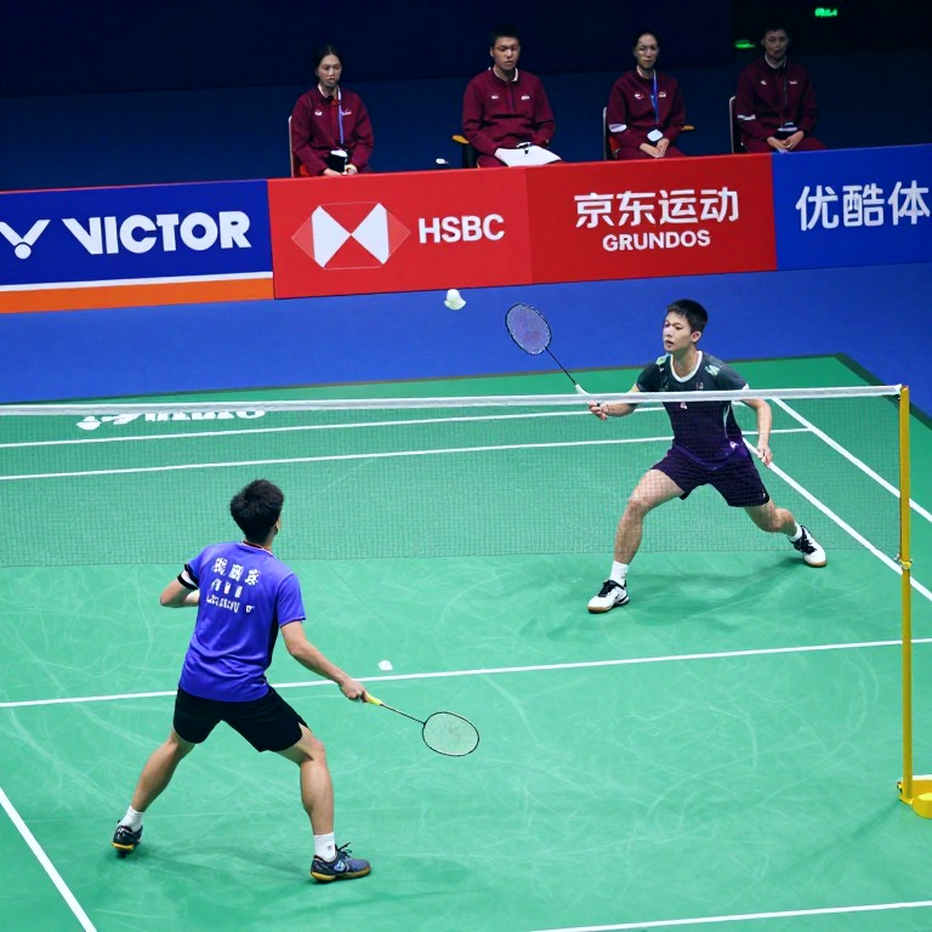
For a first-time Games competitor, this is the biggest variable. The technique may already be sufficient. The fitness may already be sufficient. But the experience of playing three elite matches in four days cannot be rehearsed in advance except by living through it.
The data void and its price
When people ask whether I am certain, I open the data table and let them answer for themselves. In this story, I have no table to open.
Things that should exist but do not: Alwi's current world ranking. The points he is defending. His head-to-head record against peers of the same age group. Average smash speed. Average rally length. Unforced-error rate in recent matches. Not one number appears in the source.
This does not mean Alwi has no results. A secondary source, meaning a related headline rather than the body of the report, mentions an Australia Open 2026 title. If accurate, this is a notable milestone. The Australia Open belongs to the Super 500 tier in the BWF system, the mid-tier group, below Super 750 and Super 1000.
A Super 500 title at nineteen is no small thing. But it is also not proof of a medal place at the Asian Games. Between those two things lies a gap that only direct head-to-head results can fill.
And here I have to be explicit: the information about the Australia Open 2026 title comes from a secondary source and needs independent verification before it is used as the basis for any quantitative assessment. The draw, the opponents faced, and the number of games played all need checking. A title won across four three-game matches has a very different physical value from a title won across five quick victories.
A second point deserves attention. A Super 500 title is usually enough to push a rising player into a more favorable seeding band at subsequent events. But because the Asian Games does not operate on the World Tour points mechanism, the benefit of that title only applies in the rest of the season, not at the Games. This is a structural paradox that analysts routinely miss.
This data void has a concrete price. It turns every judgment about Alwi into a qualitative judgment, based on impression rather than sample. And qualitative judgment in elite sport usually errs on the side of excess optimism.
Indonesian men's singles: an unnamed generational handover
Indonesia has a badminton tradition across many disciplines, but its historical strength has concentrated in doubles. In men's singles, the recent generation is tied to names that have confirmed their standing in the world's top group across several consecutive seasons.
Alwi Farhan represents the next class. The report's description of the Asian Games as his Games debut is the clearest signal of career stage: rising, incomplete, unverified at the highest level.
There is a notable pattern in how federations handle young players. When a player is placed in the final training camp before a major Games, that is an institutional vote of confidence. Federations do not place the person they regard as a backup option in the final camp. They place the person they expect to compete deep into the draw.
The confidence level of this inference is medium. It is logically sound, but no fact in the report confirms it.
At the same time, betting on a single player creates structural risk. When an entire generation is placed on one person's shoulders, the pressure stops being that person's private matter. It becomes a problem for an entire development system, and that system will have to answer if results fall short.
In badminton nations with deep traditions, generational handovers usually happen in one of two ways. The first is a soft handover, where the older class keeps competing and the younger class learns gradually alongside them. The second is a hard handover, where the older class departs and the younger class is pushed straight into a pillar role. The second way is far riskier, and its signature is a young player suddenly becoming the centerpiece of every media campaign before a major Games.
The counterintuitive angle: the word lesson in the headline
Back to the gap between headline and quote.
The headline uses the word lesson. That word suggests a transfer process with concrete content: a teacher conveys a technique, a student receives it and changes. But the only quote offered speaks of emotion. Happiness. Honor.
This mismatch is not the fault of a single report. It is the signature of a style of coverage: take an event with emotional pull, attach a technical frame the event does not supply, and let readers fill in the rest with imagination.
That style is not factually wrong. It is merely informationally thin. And when a sport needs a substantive assessment of its next generation, that style creates an information debt.
That debt is not repaid by reading more news. It is repaid only with data. Data on rally length. Data on win rate in rallies beyond ten shots. Data on performance at decisive scores. Data on unforced-error rate in the third game.
Without those numbers, every judgment about a lesson is a guess decorated with positive language.
I do not write about the winner. I write about the precise moment the balance tilts. And the moment the balance tilts in this story is not in the Tokyo training session. It is in Alwi's first match at the Asian Games, when he faces an opponent under no obligation to concede him anything.
Expectation risk and the media bubble
There is a recurring pattern in Asian sport. A young player wins a mid-tier event. The media calls it a turning point. The federation makes that player the centerpiece of a media campaign. Then the Games arrive, and that player loses in the second round to an opponent mentioned in no prior article.
This does not mean the player was weak. It means the gap between rising and ready is routinely underestimated.
The biggest risk here is not injury. Nor is it a regulatory issue. The biggest risk is expectation rising faster than actual capacity, creating a bubble that the player themselves must deflate.
There is a telling signal here. The source of the report is the federation. Federation messaging tends to be edited for image optimization. This does not mean the information is false. It means the information is selectively positive.
For a young player, being placed on the front page by the federation is both a reward and a burden. After the Asian Games, if results fall short, the same media machinery can change tone very quickly. Today's prodigy can become tomorrow's disappointment, with nothing changing except the results of a few matches.
There is an emotional indicator worth tracking here: the ratio between how far the story spreads and how much hard data stands behind it. In this case the numerator is high because the story has strong pull. The denominator is low because the facts are so few. That ratio is high, and a high ratio is a sign of overheating.
Signals to track
Four signals are worth tracking in the period ahead.
First, Alwi's competitive results at the Asian Games 2026. A reasonable benchmark is the quarterfinals. If he reaches that stage, the next-generation narrative has a basis. If he exits earlier, the assessment method needs revisiting.
Second, world ranking movement over the next six months. Entering the top twenty or top sixteen will directly affect draw paths at subsequent events, and through that, the chance to accumulate points.
Third, independent verification of the Australia Open 2026 title. Details of the draw and the opponents faced will determine the title's real value.
Fourth, Kento Momota's post-retirement role. If he moves into an official coaching or sparring role, that is a signal about the region's talent-development chain, and about how Japan uses its resources after the golden generation left the court.
None of those four signals can be read from the Tokyo training session. That is why the session, however attractive to media, is poor in information.
Closing
Between the running track, the grass pitch, and the esports arena, there is one shared pulse. And that pulse always starts in places with no spectators.
A training session in Tokyo produces no medal. It produces only one small fact, and the rest of the work belongs to real matches, where nobody returns your shot with admiration. What is worth thinking about is whether Indonesian badminton is betting on the right person, in the right cycle, or merely betting on a beautiful story written before the results had a chance to arrive.